←  Jacob Gilliam

Concept · unsolicited

Payload

Two funnelsLifecycleSept 2026Ten emails

Two pages they were missing, and the reason to send almost nothing.

Payload is a Cincinnati embedded payments company that moves about $500M a month. In August 2026 they took their first outside capital, from Fifth Third, and started pushing out of real estate into legal, insurance and professional services.

That expansion runs on demand generation, and demand generation runs on knowing which page produced the meeting. I spent a week finding out whether their site could answer that, then built what was missing at both ends of it.

Open the working build  ·  six pages, all of it clickable

The gap
Five conversion buttons, one address bar that never changes, and every article ending on the same overlay. No page to advertise to, no moment a conversion could be counted, no link to send anybody.
What I built
The two pages that were missing and the ten emails behind them: one funnel for the visitor who is ready today, one for the reader who is three quarters away.
The call I would defend
Almost none of it sends. Across both funnels exactly one email goes out unprompted, the highest intent path hands to a human rather than automating, and the revenue model shows a cost rather than inventing a number.

That is the argument. Everything below is the evidence for it, and it runs about ten minutes.

01

One finding produced all of it

A teardown of thirty pages turned up thirty one items. This case study only covers the one that mattered, because it is the one everything else hangs off.

Every conversion action on payload.com is a modal with no URL. I clicked all five in a real browser and watched the address bar.

SIGN IN           → url=https://payload.com/   opens "Please sign in"
START BUILDING    → url=https://payload.com/   opens "Enter your information"
TALK TO OUR TEAM → url=https://payload.com/   opens "Contact Us"
GET STARTED       → url=https://payload.com/   opens "Contact Us"
CONTACT US        → url=https://payload.com/   opens "Contact Us"

All five are <button> elements that open an overlay. /demo, /contact and /pricing all return 404.

That one decision cascades. No landing page to point an ad at. No thank you URL to fire a conversion on. No link a salesperson can paste into an email. No step in analytics between "visited" and "became a lead."

It is also not a design problem, which is what makes it worth raising. Nobody chose it. It is a page that does not exist yet.

02

So the first thing it needed was an address

Both opening questions come straight off Payload's own solutions nav, so every answer maps onto a page and a body of content that already exists. Nothing here asks them to describe themselves in a text box.

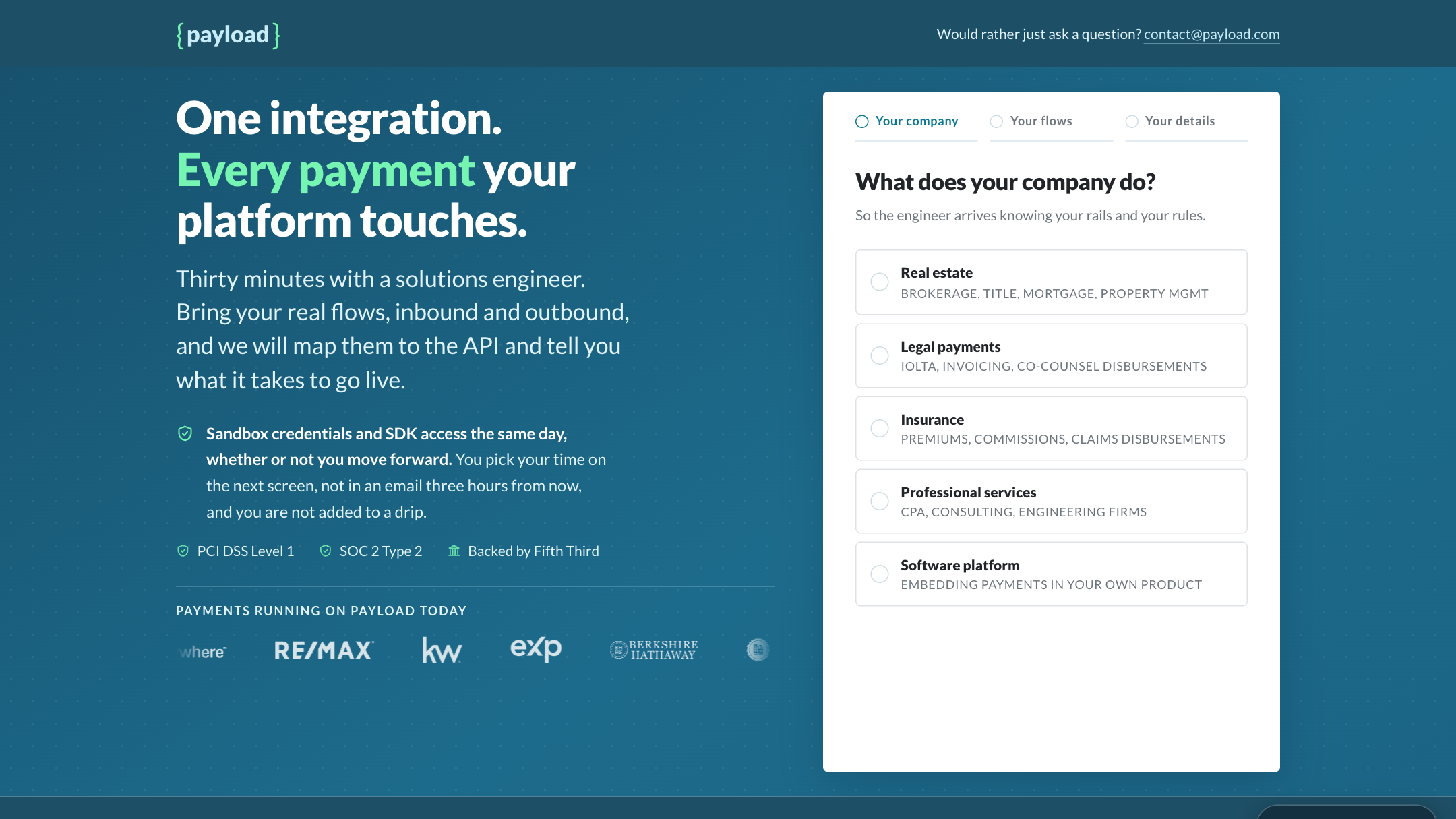
The demo page: headline, credentials, customer logo marquee, and a four screen form panel
The first screen. Card, credentials and the customer marquee all clear the fold at 869px, which is the viewport I built against rather than a round number.
03

Four decisions worth arguing about

01

Booking happens on the page, not in an email

Every email you make somebody open is a place to lose them, and intent peaks in the seconds after they submit. The calendar sits on the thank you page, so it acts on that peak instead of posting a letter to it. Email becomes the safety net underneath, which is a job it is good at.

02

Not every submission earns a calendar slot

Finix, Moov and CargoWise all collect details and promise a reply rather than exposing a calendar, and their reasons are sound. So this gates instead of choosing. Pre-launch and still deciding gets a written answer and sandbox credentials, and the page says why out loud. The button relabels itself so it never promises a calendar it is about to withhold.

03

The qualifier costs one click and comes first

Typing is the expensive part of a form, so the first screen asks for none. It also means an abandon on screen four still reports who they were, because the industry fired before a character was typed.

04

The calendar refuses dates too far out

The longer the gap between booking and the call, the more chances there are to forget it or double book it. The picker caps at five business days and shows the soonest first. Saying that on the page turns a constraint into a reason to trust the person on the other end.

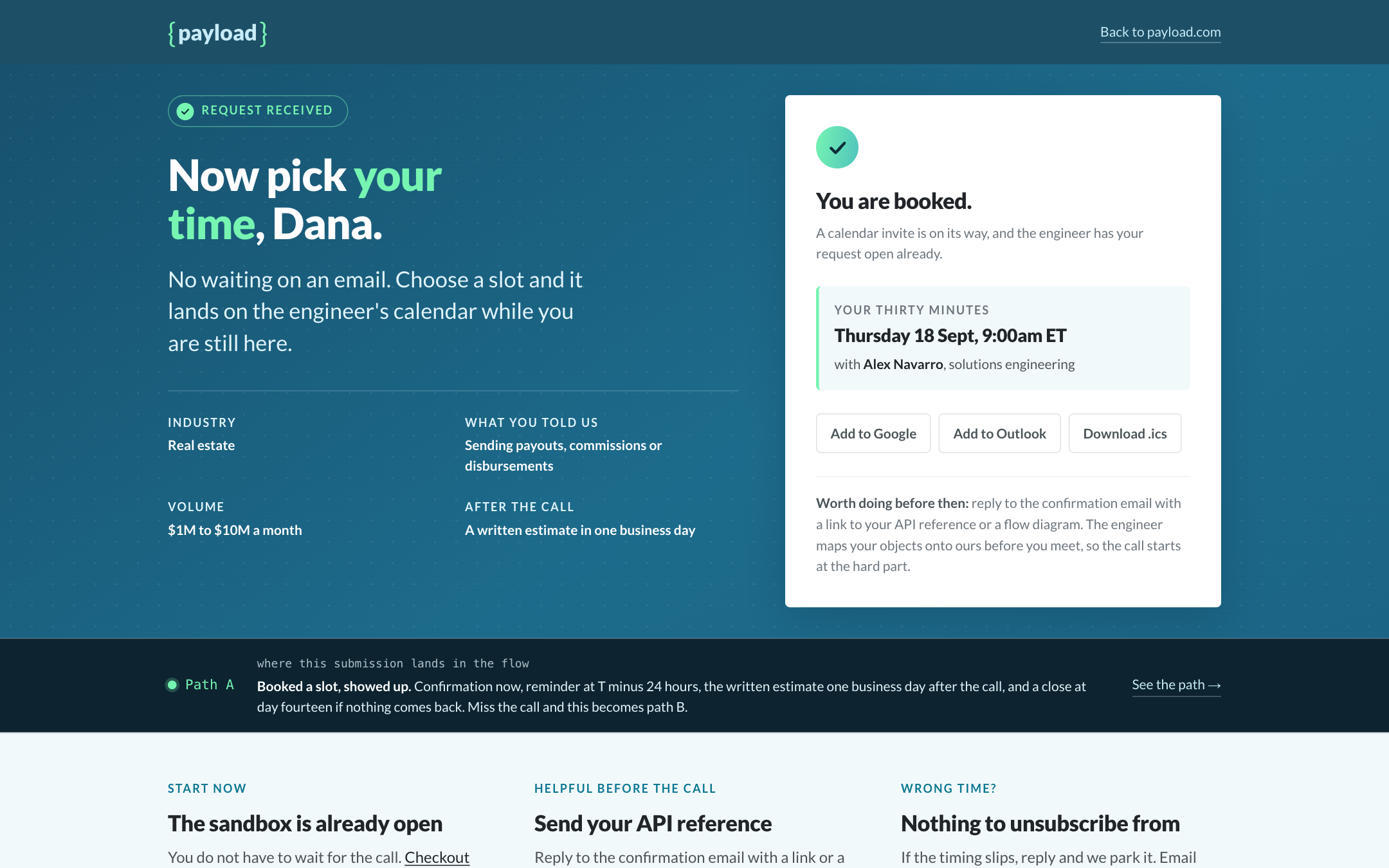
The booking screen with a confirmed slot and the path indicator band below it
The booking screen after a slot is picked.
A dark band reading: this submission is on path A, booked a slot and showed up
The band underneath it reads the same signals the flow does, and rewrites itself the moment a slot is confirmed. Pre-launch answers never see a calendar, so they land on D before the page finishes loading. It exists because a flow diagram is easy to nod at and hard to believe. This puts the branch on screen at the moment a real person would enter it, and links straight to that path in the builder.
04

Then the half that most demo pages forget

A page that converts and hands the lead to nobody has generated a to do item. Seven emails, four paths, and every path terminates. None of them loops.

PathWhat sendsHow it ends
ABooked, showed up Confirmation now, reminder at T-24h, the written estimate one business day after the call, a close at day fourteen. closed_lostafter fourteen silent days
BBooked, no show Same first two, then a recovery email inside the hour. Same day rebooking is the only kind that converts. no_show_lapsedno estimate ever sends
CNever picked a time One nudge at +24h, which says out loud that it is the only one. no_bookingto a quarterly human list
DNever shown a calendar One email inside a business day, naming the two decisions that come before a demo is useful. too_earlyany reply re enters at booking

The cadence also compresses. A sequence built for a meeting nine days out is wrong for a meeting tomorrow, so under 24 hours the confirmation is the reminder and nothing else sends.

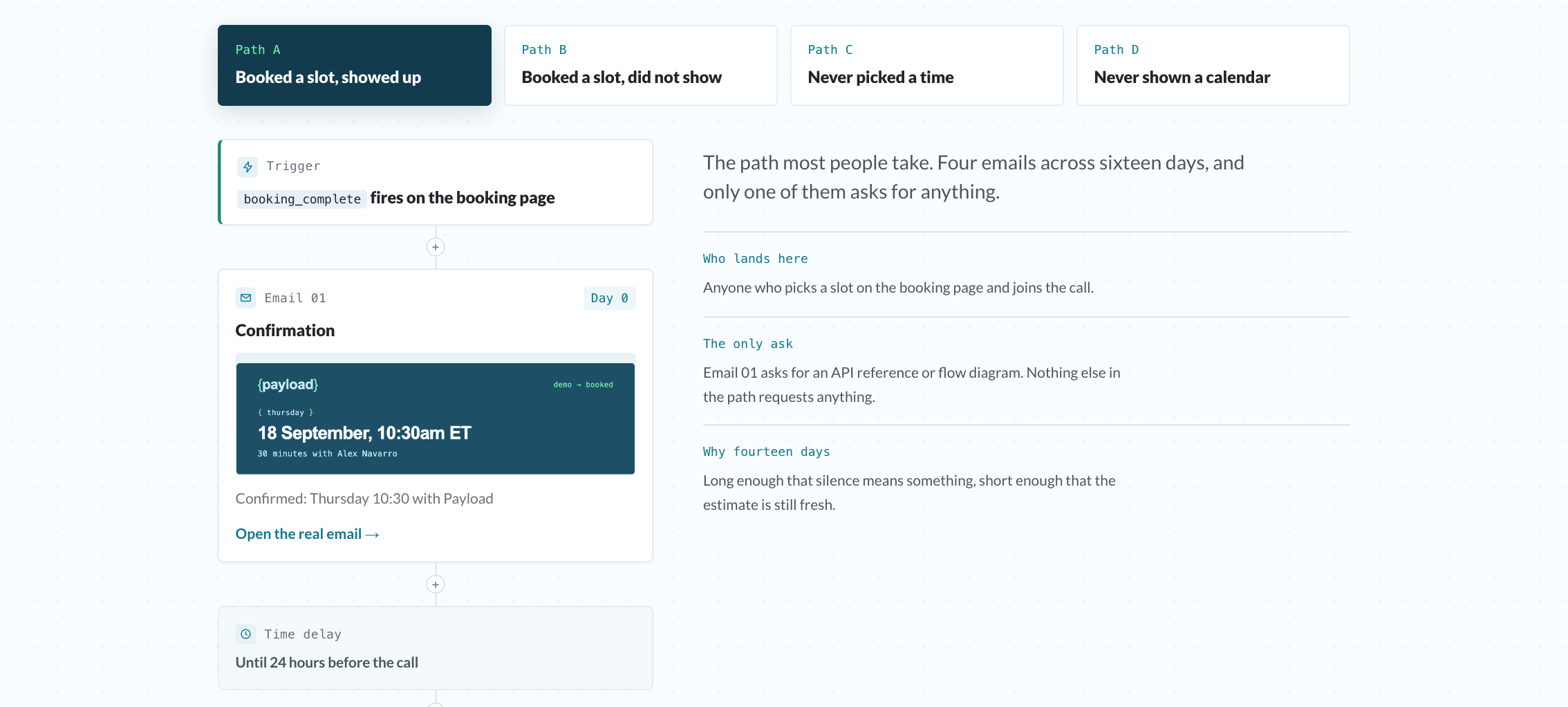
The flow diagram: trigger, time delay and email nodes down a vertical spine with the reasoning beside it
Built the way it would be built. A pill is a wait, a card is an email you can open, and the last node says what the record becomes.

Two of the seven branch by industry. Not just their reading, but the question they lead with. A title company gets asked which side of the close it starts on. A legal practice gets asked whether trust funds ever touch its balance. A platform gets asked who holds the funds.

The other five are identical across every industry, so the generator writes no variants for them. Eight variant files rather than thirty five. Personalising everything is how a sequence stops sounding like a person.

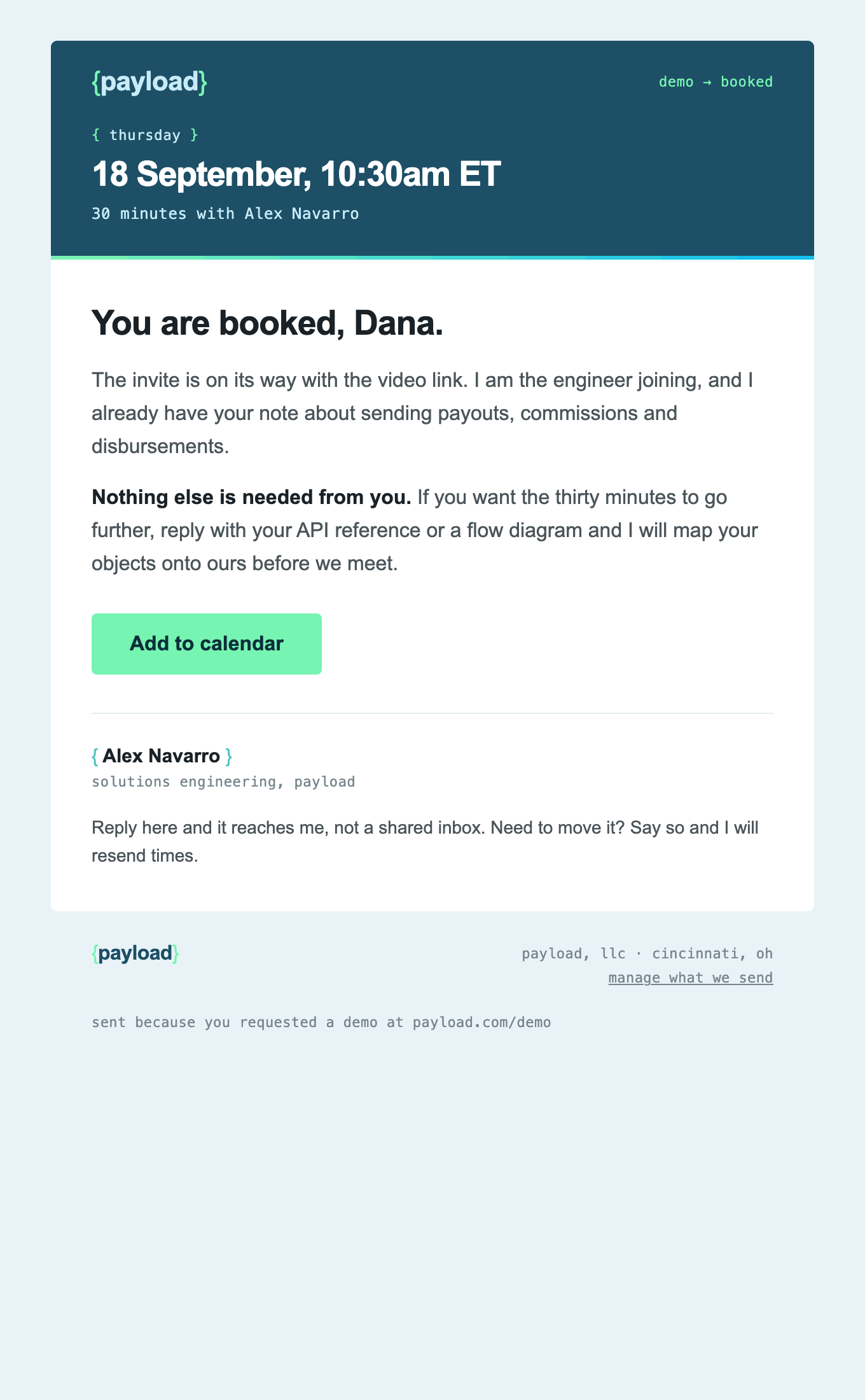
The confirmation email, with the meeting details inside the branded header
Open email 01 ↗
01, the confirmation. Seven blocks. The meeting details live inside the header so the email opens with one object that answers every logistics question.
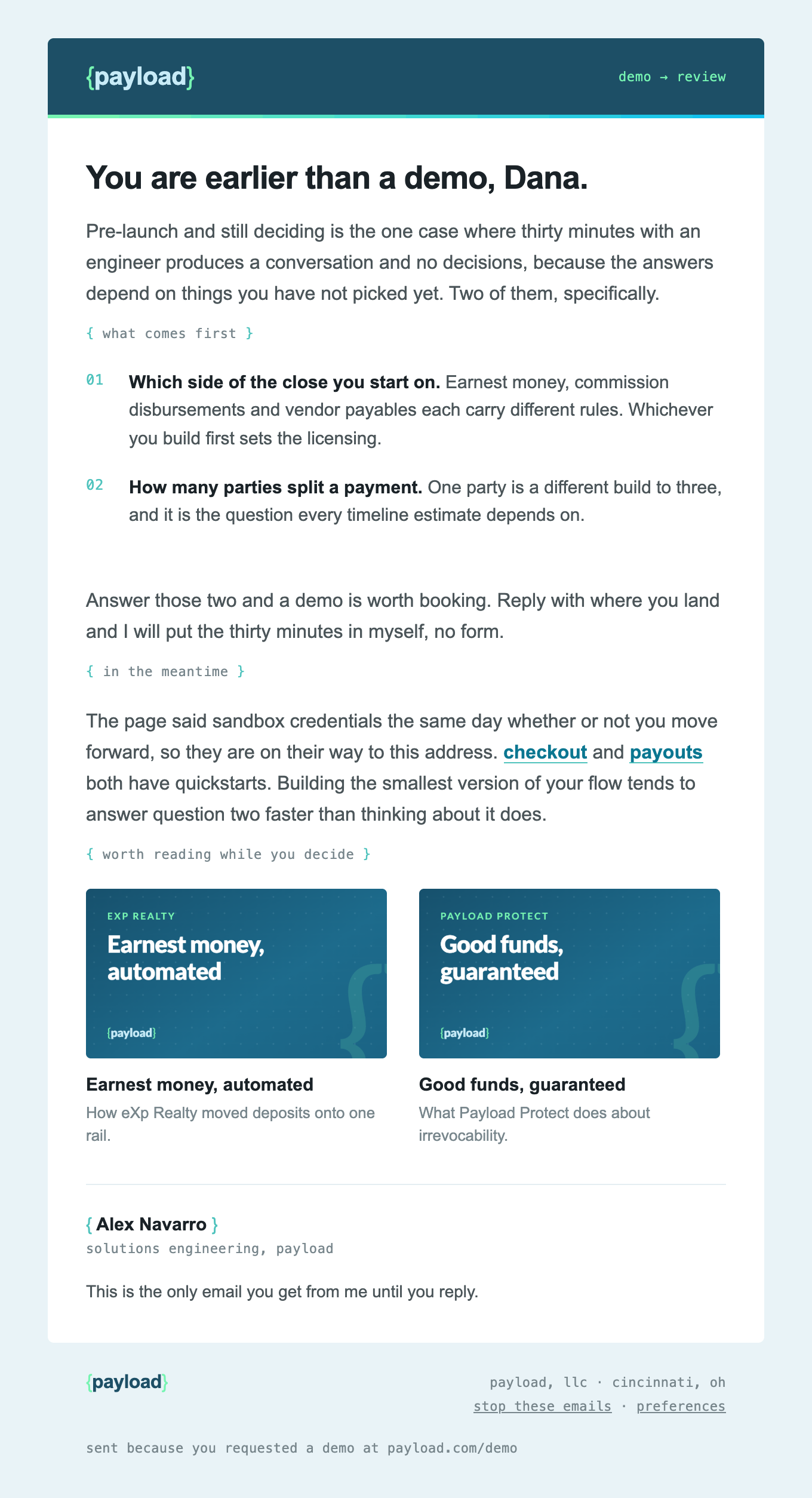
The review route email, naming the two decisions that come before a demo
Open email 07 ↗
07, the one the gate sends. The hardest to write: the form just declined to show someone a calendar, so this has to be worth more than the meeting it withheld.

All seven are table based HTML with plain text alternates, written as code rather than assembled in a drag and drop editor, and generated from one shared shell rather than seven copy pasted files. They hold up with images blocked, which is the real first impression for a chunk of any B2B list.

05

The demo page only catches the people who are already ready

Which is a small share of anyone reading. The rest are six to eighteen months out, and the site does the same thing to all of them.

Payload publishes genuinely good work on a roughly twice monthly cadence. Construction platforms, senior living platforms, title companies, trust accounting for law firms. The September piece on construction runs well past 1,500 words and is strategic rather than promotional.

There is no way to subscribe. Anywhere. No signup, no content offer, no gated download, not even a related articles link. Every article ends on the same two words.

GET IN TOUCH
  → Contact Us  (the same modal, still no URL)

Sorted by vertical, their 17 articles run nine for real estate, six for platforms, two for legal, and none for insurance. Those are two of the three verticals the funding is meant to open.

So somebody spends eight minutes on a strategic piece about embedding payments into construction software, finishes it interested, and the only thing on offer is talk to sales. They paid to produce the thinking, they rank for it, and then they hand the reader back to Google.

Same shape as the first finding, one step earlier in the funnel.
06

What a platform lead actually needs is a number

A software platform deciding to embed payments is not one person clicking a demo button. It is a product lead, a CTO and a CFO, arguing about build versus buy, revenue share and compliance liability, across two or three quarters. Nobody reads one article and books a call.

What moves it is the thing the product lead carries into the room. So I built that instead of a newsletter box.

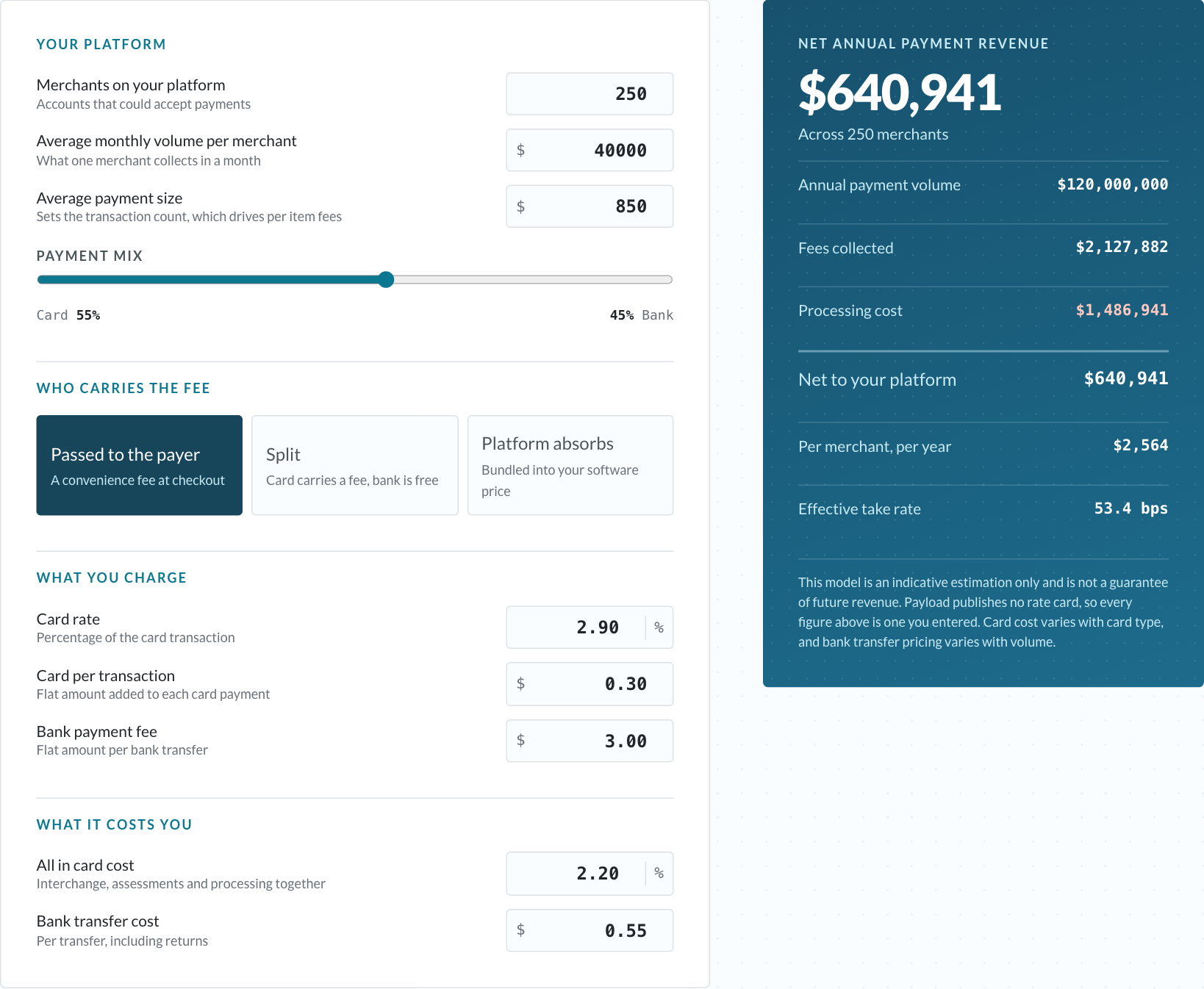
The revenue model: nine inputs on the left, results on a dark panel on the right
Nine inputs, and not one supplied figure. Payload publishes no rate card and /pricing returns 404, so every number on the panel came from a field the visitor filled in. The fee structures are quoted from their own /capabilities/facilitate.

Fee ownership is the input that makes it theirs. Payload's own page leads with it: the platform absorbs the fee, passes it to the payer, or splits it. Rainforest, their closest competitor, has an ROI calculator in its primary navigation and no such control. It matters more than anything else on the panel, because in earnest money and legal trust payments the payer routinely carries a convenience fee, which means the platform's revenue is not a spread on interchange at all.

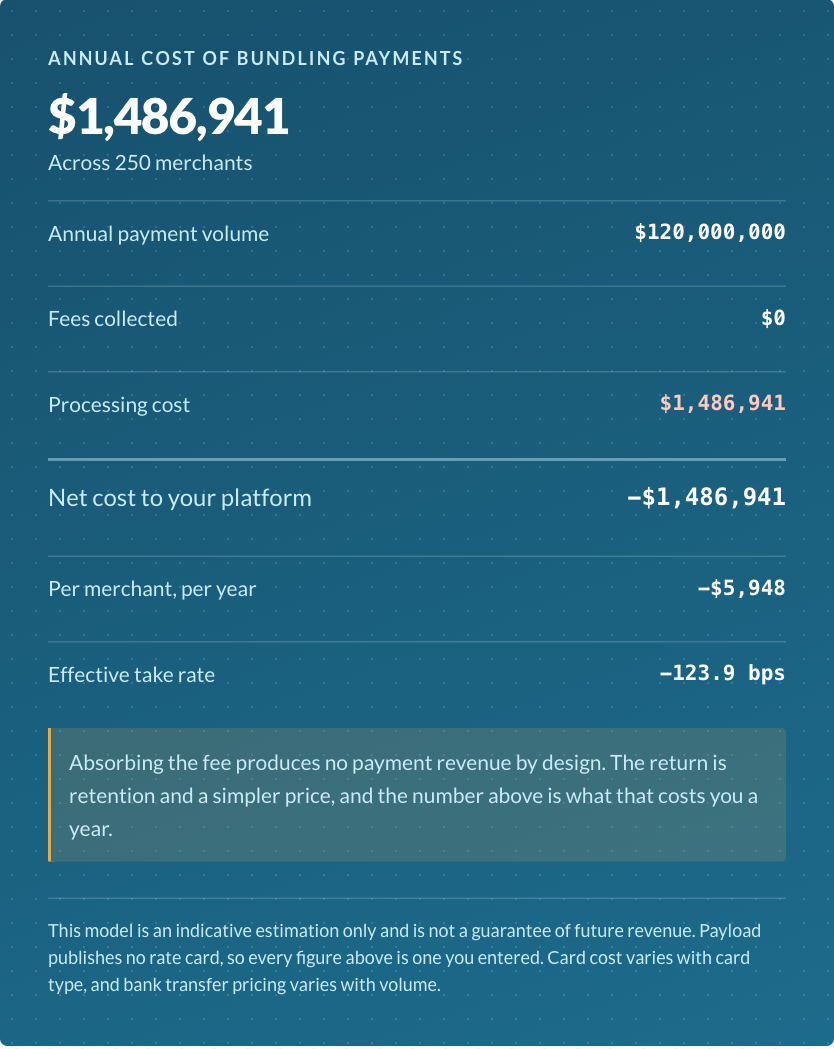
The results panel reading Annual cost of bundling payments instead of revenue

When the platform absorbs the fee, there is no payment revenue, so the panel refuses to show any. The headline flips to annual cost, and a note says the return is retention and a simpler price rather than a number.

A calculator that prints an encouraging figure the model did not produce is lying, and most of them do. A second guard fires whenever the charged rate sits below the cost rate, in any mode.

Defaults give 250 merchants at $40k a month, so $120M of volume and a net of $640,941. That is 53.4 basis points, which lands inside the 50 to 100 range embedded payments actually runs at.

The tool is ungated. What costs an email is the spreadsheet, because the person who ran the model is not the person who approves it, and a figure on a web page does not survive that room. One question comes with it, and it is the same vertical the demo form asks on screen one, so one person is one record across both.

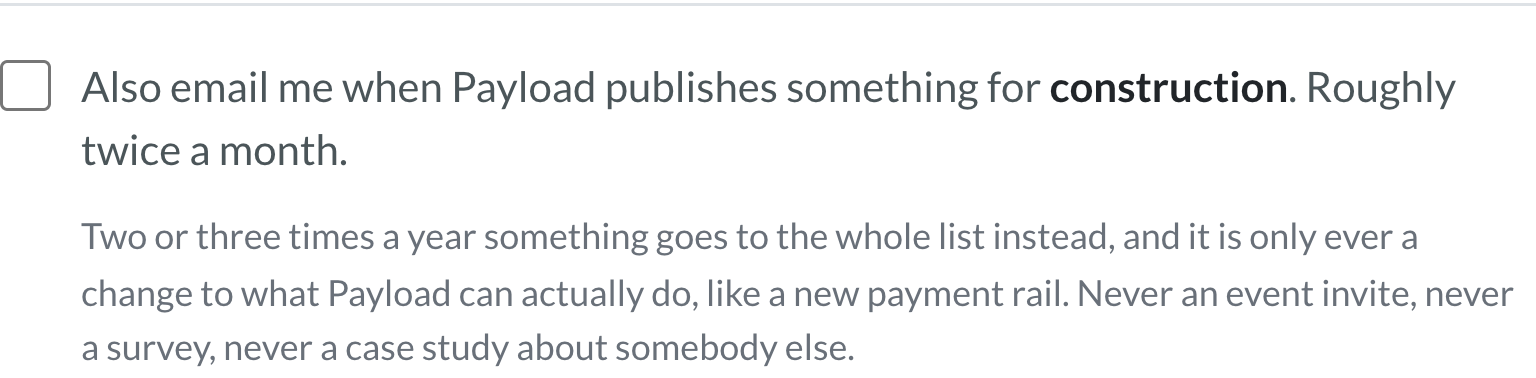
An unticked checkbox offering articles for the visitor's industry, with the scope written underneath
Payload publishes RE/MAX Canada and the Alberta Real Estate Association as customers, so Canadian recipients exist and CASL applies. Asking for a spreadsheet is not permission to send articles. The box stays unticked because a box somebody did not tick is not consent, the label names the vertical they just picked rather than saying newsletter, and the scope sits next to the box rather than in a policy, because the scope is the part people are agreeing to.
07

Then the part that is mostly deciding not to send

Three emails exist behind that download. The most any one person receives is two, and exactly one of them sends without a signal the reader created.

A drip assumes everyone who downloads something wants a relationship. Most of them wanted a spreadsheet.

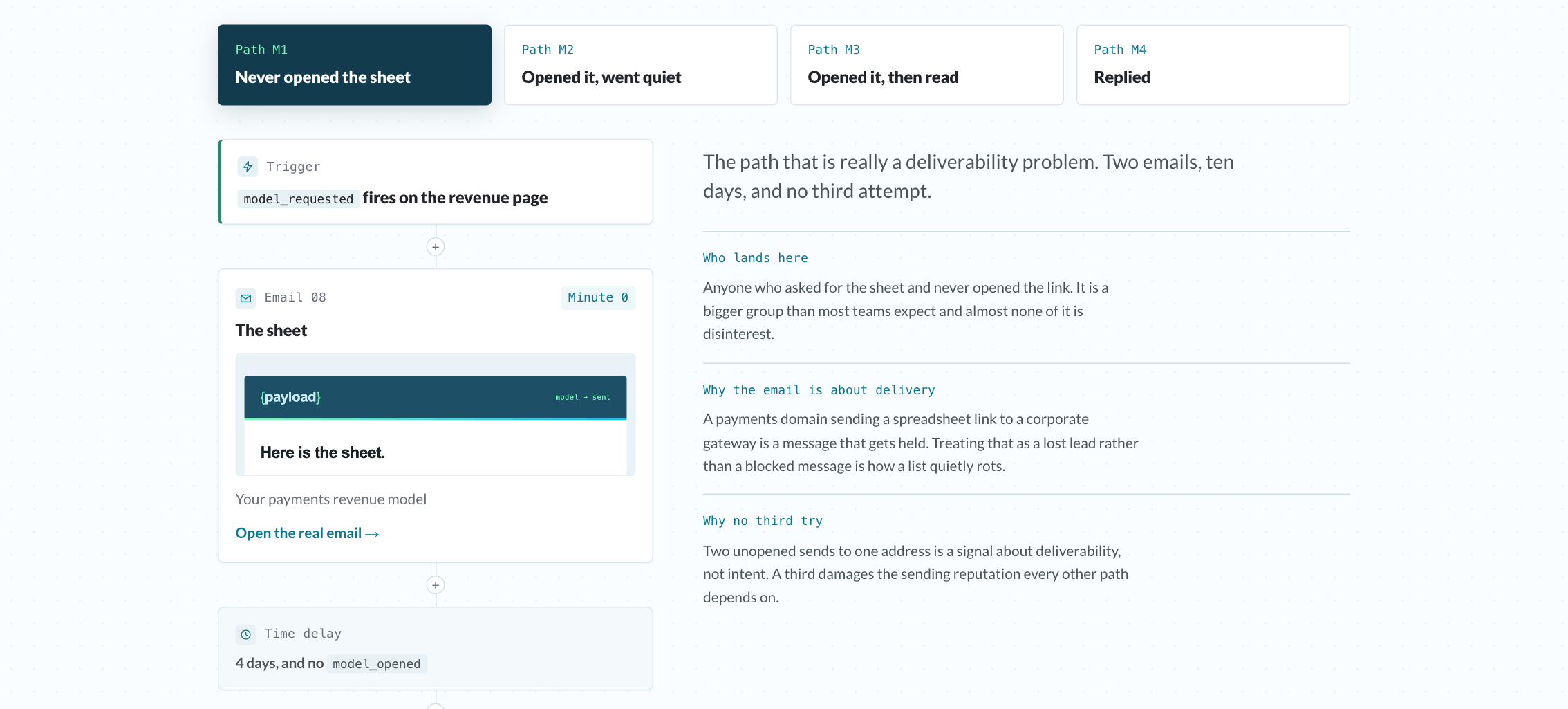
The flow after the model: four paths shown as tabs, with the reasoning beside the nodes
Four paths, all terminating. The one where the sheet never opened is a deliverability problem rather than a lost lead, so it exits to a report grouped by recipient domain: one unreachable person is noise, eleven at one company is a blocklist.

The path that earns a demo offer does not send an email. Two signals the reader created, on two different days, and then the record goes to a person with both signals and the figures attached. They write one real email in their own words. An automated "ready for a demo?" to somebody who read two articles is the move that makes a good sequence feel like a machine, and if nobody acts inside two business days the record closes rather than escalating. A sequence that cannot be staffed should stop.

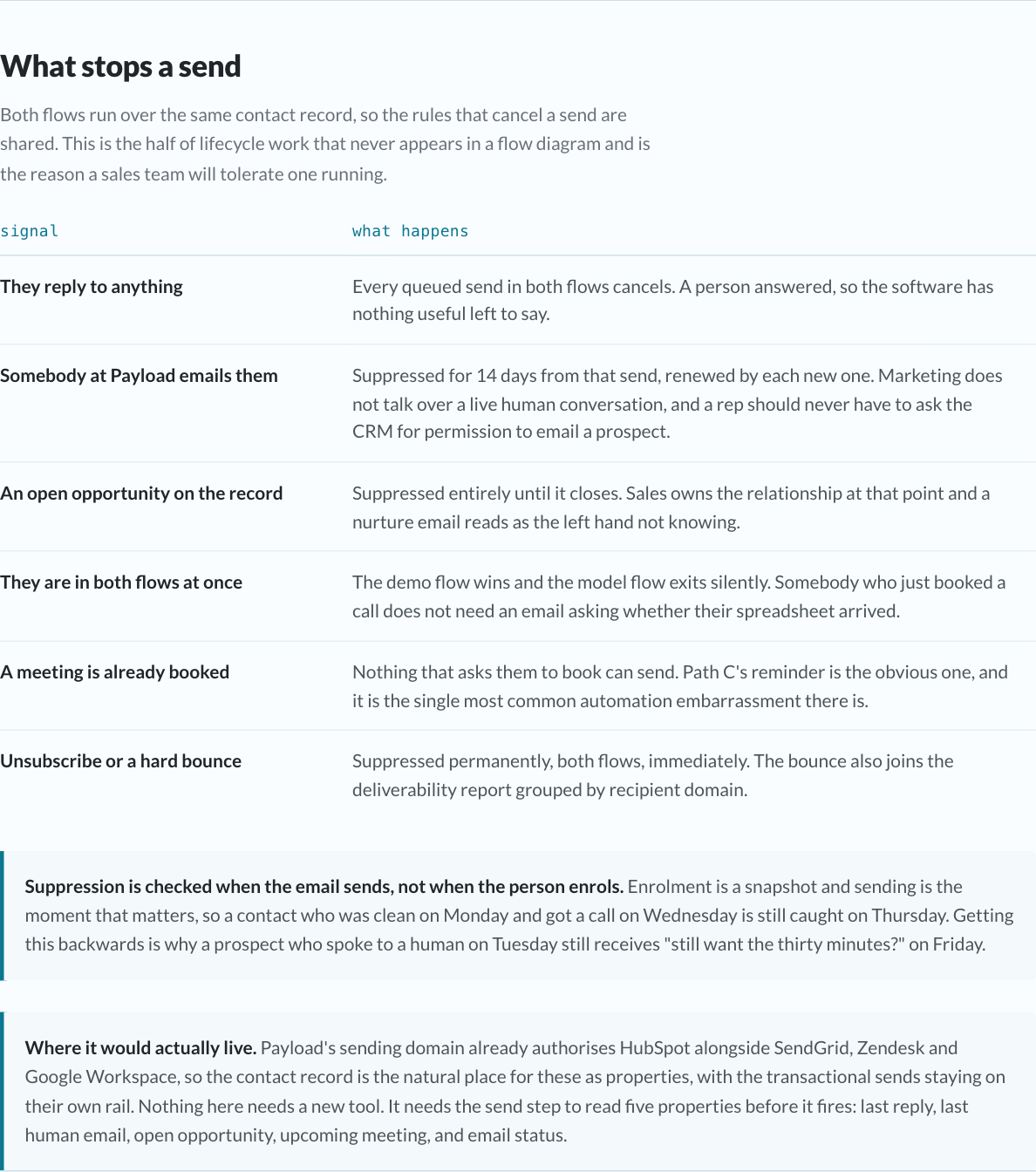
Underneath both flows sits a shared set of rules for cancelling a send.

A table of six signals that cancel a queued send
The load bearing line is the one underneath: suppression is checked when the email sends, not when the person enrols. Enrolment is a snapshot. Getting it backwards is exactly why somebody who spoke to a rep on Tuesday still receives "still want the thirty minutes?" on Friday.

Where it would live is answered from their DNS rather than guessed. Their sending domain already authorises HubSpot alongside SendGrid, Zendesk and Google Workspace, so these are properties on a contact record that already exists. Nothing here needs a new tool. It needs the send step to read five properties before it fires.

08

What all of it would let them report

Which campaign produced a meeting

Not which campaign produced a session. Step one fires form_step_complete with the industry before anyone types, booking_complete carries the meeting. Join those two and paid search has a numerator it did not have.

A no show rate at all

Bookings minus completed calls. On the current site neither end of that subtraction is recorded, so the number does not exist and nobody can be asked to improve it.

Whether the page is telling the truth

The page promises a written estimate in one business day. estimate_delivered minus call_completed answers that per engineer, every week. A promise nobody measures is one that quietly stops being kept.

Whether the content is worth its cost

Not pageviews. form_step_complete on the model page carries the vertical, so an article's value is the qualified addresses it produced, per vertical, against the two it has for legal and the none it has for insurance.

A closed lost reason that fills itself in

The last email offers three answers and names the third, no, out loud. Most pipelines are full of deals nobody wants to mark dead. Asking plainly is cheaper than guessing.